Wednesday, April 10, 2013

Tuesday, February 19, 2013
Assignment #2: Memes
Imma Let You Finish - Claudia Andrade
this is where it goes
The Cinnamon Challenge- Melody I-Fan Tien
- The details/ descriptions of the "meme".
The Cinnamon Challenge is to swallow a tablespoon of cinnamon within 60 seconds without drinking anything. People then upload the videos of themselves attempting this challenge onto the Internet. As most of the videos have shown, this challenge results in "coughing, gagging, and vomiting." The Cinnamon Challenge was started by Michael Buffinton and Erik Goodlad in 2001. Buffington posted a blog article on Goodlad's attempt at The Cinnamon Challenge. The challenge did not gain popularity back then. Several YouTube videos of attempting such challenge were uploaded in 2006. The very first video was titled "Pipe Attempts the Cinnamon Challenge." Even then, The Cinnamon Challenge was not at its peak of popularity yet.
- The very first cinnamon challenge

[http://imageshack.us/a/img515/704/2001m.jpg]
- The very first video of the cinnamon challenge
- When did this begin to become popular/famous on the Internet and Why?
Though the challenge started in 2001, it was not popular back then. It increased in popularity in 2007. Notice that it is mentioned above that several YouTube videos of this challenge were uploaded in 2006. Thus, I would argue that the reason The Cinnamon Challenge became so popular is largely due to the social media. Because sharing videos became so easy in the online community, everyone could easily have access to the videos about this challenge, which created a good means to understand and find out more when people are curious, or upload their own videos attempting such challenge to share with the world. What drives people to watch such videos might be the seemingly exaggerated reaction of people who are attempting the challenge. It is in our human nature that we are more attracted to surprising/unpredictable things. People would not want to watch videos that are boring (which basically means videos that do not surprise or entertain us). Since most of the people in the Cinnamon Challenge videos show signs of critical reactions, such as serious coughing, vomiting, and crying, others will be curious to watch such videos- thus the popularity rises. Moreover, people might wonder, "is this challenge really that difficult?"; thus, they might want to try it themselves and upload the videos on the Internet as well. Overall, though there are many reasons that might support why this challenge became so popular, I would argue that it is the video- sharing online community that really fueled the possibility of this challenge to gain popularity.
- Examples of people showing discomfort after attempting the challenge
- How popular did it become and over what time span? (Include Google)
The time span for The Cinnamon Challenge is quite long. As mentioned above, the challenge started in 2001, and increased in popularity in 2007, with the peak in October according to the Google Insight Interest graph (link provided below). This corresponds to a YouTube video because the video that accumulated the most views in 2011 was uploaded in 2007. Over the whole time span, The Cinnamon Challenge search on Google reached its peak in late 2011. This corresponds to the video uploaded by Anna Diaz, which received over 2.9 millions views in the first two months of upload. In 2012, the Google Insights graph shows that the number of searches dropped drastically. However, many Cinnamon Challenge videos have accumulated and are still floating on the web; there are also many Twitter posts about this challenge.
- "Google Insights" Interests.
- Other memes that may have emerged from this or have been influenced by this
- The Bread Challenge
The challenge is to eat one slice of bread in under 45 seconds. Though this challenge does not seem too difficult, it is similar in style with the Cinnamon Challenge; thus, the Cinnamon Challenge might have been influenced by this.
- The Saltine Cracker Challenge
The challenge is to eat at least five saltine crackers (soda crackers) within 60 seconds without drinking anything. This is very similar to the Cinnamon Challenge; thus, the Cinnamon Challenge might have emerged from this cracker challenge.
- Milk Challenge
The challenge is to consume a large amount of milk within a set period of time without vomiting. Since this challenge also sets a constraint time, the Cinnamon Challenge might also have been influenced by this.
- Banana Sprite Challenge
The challenge is to quickly eat two bananas and drink two liters of Sprite without vomiting. Again, this challenge involves eating large amount quickly, so the Cinnamon Challenge might have been influenced by this.
Paula Deen Riding Things - Brett Johnson
- Where and how this meme became popular?
The Paula Deen Riding Things hit the internet on February 28th, 2011. Pictures of her riding fellow celebrity chef Robert Irvine like a horse were posted on the internet after the South Beach Wine and Food Festival. Only hours after the photos were posted, two college students, Nick and Robbie, created a Tumblr with the title of the meme. Days later Jimmy Fallon retweeted the meme, which started a train of features on various popular internet blogs.
In addition to the first Photoshop jobs of her riding items ranging from roller coasters to sticks of butter, the two students provided a template for others to make their own creations. I think that this was an important step in the spread of the meme, as form day one it was made as easy as possible for people to iterate on the meme and contribute to its spread.

- Details / Description
Paula Deen is a cooking show host form Georgia. She is known for featuring recipes on her show that include extremely high amounts of fatty, fried foods, such as a hamburger sandwiched between two donuts. This is why many of the GIFs feature her riding a stick of butter or on some bacon wrapped piece of food.
She was shown some of the images on her appearance on the Today Show, laughing it off and generally seeming entertained by people’s creations. Time magazine ranked Paula Deen Riding Things number 8 on their top memes of 2011, beating internet sensations as Chuck Testa.


From the official Rolling Stone blog
- Popularity Over Time
This meme peaked in its early stages, declining in popularity shortly thereafter, with a modest increase in April 2011. Since its inception, the meme has a general downward trend in popularity.

- Memes Spawned/Influenced by Paula Deen Riding Things
A product of this meme is Kim Jong II Looking at Paula Deen RIding Things, a fusion of this meme and the popular Kim Jong II Looking at Things meme.

http://25.media.tumblr.com/tumblr_lw097vX9qi1r5gkooo1_500.png



Nyan Cat – Yushan Huang
- The details/Description of the “meme”
Nyan Cat, or Pop Tart Cat, is an animation that features a cat with a pop tart body in a running motion. It is an eight-bit animation that is often displayed in an outer space background. The cat is based on a Russian blue cat named Marty, owned by the Nyan Cat creator of Chris Torres of the site LOL-COMICS. The pop tart is cherry flavored, with pink frosting and dots. The Nyan Cat idea came to Chris Torres during a Red Cross charity drawing event on a live streaming site know as Livestream.
LOL-COMICS: http://www.prguitarman.com/index.php
Livestream: http://new.livestream.com/
- Nyan Cat:
- When did this begin to become popular/famous on the internet and why?
Nyan cat was originally posted on April 2nd, 2011 and quickly spread through social media websites due to likes and reblogs. However, its popularity most came later. On April 5th, 2011 a YouTube user known as “saraj00n” posted a video using Nyan Cat. This video features the Nyan Cat set to a Japanese Vocaloid song “Nyanyanyanyanyanyanya” in a loop. In a mere two weeks, the video has gained over one million views. Since then, longer versions of the loop have been posted on YouTube, including ones that can last several hours.
- Original Nyan Cat Video:
I think the reason why this meme became famous is that the repeating music and the adorable, simple cat image can easily catch people’s attention. This meme appeared on several popular blogs and social networking sites including Memebase, Buzzfeed, Tumblr, Facebook, and more on April 10th. Two days later, Tosh.0 blog, CollegeHumor and G4TW posted remixed Nyan Cat video. There are many remixes, spinoff variation, and customized form of original Nyan Cat video on Youtube, which all help spread the popularity of Nyan Cat.
- How popular did it become over that time span?
The Nyan Cat is still a fairly popular meme even today. The original video has over 93 million views, while many other remixes also have millions of views. There are over 45,000 videos on YouTube about Nyan Cat. The Nyan Cat reached its peak popularity on June, 2011. It has made news on the San Francisco Chronicles, CBS news, PCWorld, and msnbc. Since then, Nyan Cat have been made into video games, appeared in commercials, and even YouTube and Windows progress bars.
- Nyan Cat Google Insight:
- Other memes that may have emerged or influenced by this
There are a lot of Nyan Cat spin-offs and crossovers on the internet, to the point where it would be impossible to try and list them all. Below is a list of just some that I find to be interesting.
- Nyan Dash: A crossover between Rainbow Dash from My Little Pony and Nyan Cat.
- Endless Nyan Cat: infinite loop of Nyan cat video playing over and over again, the goal is to see how long you can stay on there listening to it.
- Nyan Pig: A pig instead of a cat set in the same space and a similar song http://www.youtube.com/watch?v=fG8R4DtQ-Vk
- Pokemon Nyan Cat: Every pokemon in Nyan Cat form
- Minecraft Nyan Cat Mod: A minecraft mod that allows you to ride on a Nyan Cat to fly around the minecraft universe.
- Source
Kim Jong-Un Looking at Things - Sina Oeyri
How and where this meme became popular/description:
Shortly after the leader of North Korea Kim Jong-Il's death was announced in 2011, a Tumblr blog called " Kim Jong-Un Looking at Things" immiediately popped up, following the original blog "Kim Jong-Il Looking at Things".
The blog Kim Jong-Il Looking at Things was first launched back in October 2010 by the Portoguese art director Rocha, featuring pictures of the North Korean dictator staring at all sorts of things. Rocha startet the blog after seeing the sporadically released photos by North Korea's one and only state-run news agency, of Kim Jong-Il making "on-the-spot" guideance visits at schools, factories etc. The inspiration behind launching the blog was the character of these pictures: "possibly sleep deprivation-induced insanity”(Washington Post).
Kim Jong-Un, Kim Jong-Il's son, suceeded his father's dictatorship and like father, like son, he also tends to simply look at things. The blog was obviously inspired by Kim Jong-Il Looking at Things and is refered to as a "second-generation meme". The Kim Jong-Un blog showcases Kim Jong-Un gazing at food (http://cdn.theatlantic.com/static/infocus/kju020112/k24_RTR2VSLN.jpg), clothes (http://kimjongunlookingatthings.com/wp-content/uploads/2012/11/childs-jacket.jpg) and boots (http://kimjongunlookingatthings.tumblr.com/image/28654326633) and all kinds of other stuff.
Unlike his father, who always kept the same mirthless expression no matter what he was looking at, (http://www.thewaygookeffect.com/2010/12/kim-jong-il-looking-at-things.html), Kim Jong-Un shows a bit more visible affection (http://imgur.com/gallery/0N8tk).
Popularity over time:
This meme never reached the same popularity as Kim Jong-Il Looking at Things meme(which became hugely popular with 50000 followers at Tumblr). It peaked in its early stages, declining ever since.
The Kim Jong-Un Tumblr blog at http://kimjongunlookingatthings.tumblr.com ("a shameless knock-off and tribute to the original"), still appears active, posting pictures of Kim Jong-Un looking at things.
"Google Insights" Interests:
Other memes that may have emerged from this or have been influenced by this:
The day after the new blog was launched in 2011, a Quickmeme titled "Hungry Kim Jong-Un" was created, showing pictures of Kim Jong-Un labeled: "Ok, so can I eat this?"
In addition to the Kim Jong-Un Looking at Things meme, Kim Jong-Il Looking At Things inspired two new photoshopped memes: “Kim Jong-Il Looking At Things in the Afterlife” and “Kim Jong-Il is No Longer Looking At Things.”
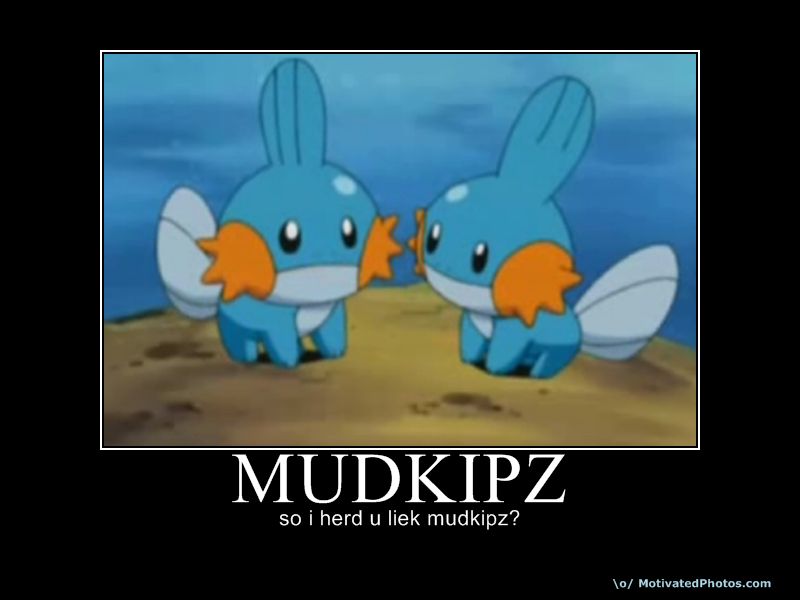
“Do you like Mudkip?” - Ernestina Garcia
Description
Posting the image of a mudkip, a blue and orange water-type Pokemon character, or Pokemon related images with the words deviating around one hearing that someone likes mudkips. Through the spread over the years spelling variations were adopted including the spelling of “liek” as well as adding z at the end of the name “mudkipz.”
When It Began
It all began in 2005 within the website DeviantART where a group called MudKipClub encouraged other users to post and share Pokemon fan art. Owner of the community began posting the phrase “so I herd you like mudkips” on other users comment wall as an invitation to join. Throughout 2005-2006 the catchphrase became popularized through a copypasta story, a story of a prank on a boy dressed as Ash Ketchum who began humping a stuffed mudkip toy in the middle of a school hallway, which began to circulate on the 4chan website.
Popularity
The copypasta was later reposted in 2007-08 on 4chan along on other popular forums such as DevianART, Playstation Universe, Naruto and NeoGAF forums just to name a few. Gaining large amounts of popularity among game and internet users who where already familiar with the Pokemon media franchise second to that of Mario’s, using the already huge set Pokemon franchise to gain popularity and spread. Its use also included the 2008 Project Chanology protests, where many Anonymous protestors used mudkips on their signage and used the
catchphrase (do you like mudkips?) as a way to identify each other.

Influenced
Generated numerous YouTube tribute videos.


• The details/description of the "meme," person, event, etc.
• How popular did it become and over what time span? (include "Google Insights" interest).
• Include videos or images when relevant to illustrate your description.
Planking-Alemka Pinjo
Most of us are familiar with the Internet phenomena “planking” and some of us have even participated in this global trend! Planking became popular through the Internet in the beginning of 2011. Quickly facebook and other social network users were spammed by weird pictures of people lying flat out on different items and buildings in different private and public location with their face down. That is what planking is about: finding the most random place to “mimicking” a wooden plank, take a picture and share your image through social media.


The concept has actually been “invented” twice. First two friends; Gary Clarkson and Christian Langdon invented it in Somersett during the year of 2000. At this time it was named the “Lying down game”.
A couple of years later it emerged into Australia and got the name “Planking”. The growing popularity was a result from all the media attention after the game became popular in Australia. A few local radio stations got hold of it and decided to run planking-competitions and suddenly people all over the world started to plank.
At the facebook fan page of the lying down game, (link: http://www.facebook.com/pages/The-Lying-Down-Game/96550134929?sk=info) it is written: “This is the Official Lying Down Game© group which has a copyright certificate and was founded when facebook first started. Unfortunately there are some people who have copied our idea and our group and labeled it as PLANKING which was created after we hit world domination on the internet late 2009, but all members of that group are misguided as we are the official and original creators of the game. This group is so old that it was nearly archived.”

So, even if we are not familiar with this name, we have become familiar with the concept in the recent years. Theoretical, Gary Clarkson and Christian Langdon are the inventors and their primary intension was to confuse people (as they have written on their official facebook page.)
They created the game in 2000, but it was not before 2007 that their friend Daniel Hopping took the phenomenon online.
At the “planking” facebook-site (link: http://www.facebook.com/OfficialPlanking/info )there are as of today 1 112 291 members. According to “Google Insights” the search interest of planking was most popular in July 2011.
Planking is considered to be a dangerous game to play (In Australia a 20 years old boy fell down from seventh floor, while he was planking at the balcony.) The meme called “teapotting” emerged from this game. It is seen as a much more safe version of planking and the concept behind it is that people shell pose as a teapot (with their hands and bodies).
Chuck Norris Facts – “Chuck Norris died 20 years ago, Death just hasn´t built up the courage to tell him yet.”
By Camilla I. Roesbak

• When did this begin to become popular/famous on the Internet and why? Provide a context and offer an analysis of why you think this became so popular (if no obvious reason presents itself).
The precursor to this meme dates back to May 12th, 2004 when Vivendi Universal Entertainment merged with NBC. This merger ultimately led to the running gag of Walker Texas Ranger Lever (featuring Chuck Norris as Cordell Walker) on the Conan O´Brien Show. An example of this segment can be seen in the video below:
Then with the release of the movie The Pacifier on March 4th, 2005, starring Vin Diesel as a babysitting Navy Seal the SomethingAwful forums started a discussion called Post Vin Diesel Facts. Ian Spector saw this as an opportunity to create a website for these facts, however, the interest soon died down. He then decided that in the summer of 2005 people should be allowed to vote on another person who should have such a site created about them. Even though he was not a candidate on the voting list, the winner was Chuck Norris! This outcome, and ultimately the memes popularity, is believed to have been strongly influenced by the aforementioned (and very popular) segment with the Walker Texas Ranger Lever on the Conan O´Brien show.
• The details/description of the "meme," person, event, etc.
Chuck Norris is an American man, born on March 10th, 1940. He is an international film and TV actor and author, though he started out as a martial art enthusiast who opened his own karate studio. He is, in fact, the first man from the Western Hemisphere to receive the eighth degree Black Belt Grand Master ranking in Tae Kwon Do. One of his most popular appearances as an actor is as Texas Ranger Sargent Cordell Walker, who is a former Marine soldier who served in the Vietnam War and puts his faith in the Code of the Old West. In the show, Cordell Walker is also a martial arts specialist, renowned by viewers/fans for his roundhouse kick.
Chuck Norris as Sgt. Cordell Walker.


Chuck Norris facts are described on Urban Dictionary as an Internet phenomenon of satirical “facts” about martial artist and actor Chuck Norris. The “facts” tend to involve absurdly exaggerated claims of Norris´ toughness, attitude, virility and masculinity stated in an absurdly serious tone. One will also find references to his famous roundhouse kicks - implying that these kicks can carry out almost any job. There was even made Pokémon-like cards of Chuck Norris as a result of the Chuck Norris Facts (as seen above). Below are some examples of Chuck Norris Facts, all taken from http://www.chucknorrisfacts.com/ :
- "There is no theory of evolution. Just a list of creatures Chuck Norris has allowed to live."
- “Chuck Norris doesn´t have to lick a tootsie roll lollipop, it melts on fear.”
- “When the Boogeyman goes to sleep every night, he checks his closet for Chuck Norris.”
- Chuck Norris counted to infinity. Twice.”
- “Fear of spiders is arachnophobia, fear of tight spaces is claustrophobia, fear of Chuck Norris is called Logic.”
- “Chuck Norris has a grizzly bear carpet in his room. The bear isn´t dead, it is just afraid to move.”
You can find more Chuck Norris Facts on other pages as well, for example on:
- http://thechucknorris.tumblr.com/
- http://thechucknorris.tumblr.com/

• How popular did it become and over what time span? (include "Google Insights" interest).
The meme was very popular, not only in the US, but worldwide. Shown below is the regional interest on Chuck Norris Facts at its peak popularity.
Despite the memes popularity when it first surfaced and the time following, it is no longer the hit that it used to be. Below is the Google Insight on the memes popularity over time, ranging from January 2005 until February 2013.

We see that the overall trend of the memes popularity has been slowly but steadily sinking downwards. There are a few factors for why this has happened:
1. People have simply lost interest and are more engaged in newer memes;
1. People have simply lost interest and are more engaged in newer memes;
2. The use of the Chuck Norris Facts in Family Guy may have been a contributor in its loss of popularity;
3. Chuck Norris himself – through his own participation in approving of certain beliefs and politicians. These were thought to be quite conservative, and to some it was also offensive.
On some threads it even seems that the use of the Chuck Norris Facts now actually serve to make fun of Chuck Norris, as he has been labeled a “looser” in certain communities.
• Include other memes that may have emerged from this or have been influenced by this.
It also appears that the Chuck Norris Facts have inspired, if not memes, other similar trends to arise. There is an Indian actor named Rajinikanth who, in India, there exists similar joke-like factoids and quotes. They are not only inspired by the Chuck Norris Facts, but some of the Rajinikanth are actually the exact same as Chuck Norris Facts only with Rajinikanths name inserted. There also exists original Rajinikanth Facts.

In addition to this, Anatoly Wasserman, a well-known Russian intellectual, political analyst and journalist also has similar jokefacts made up about him. Two other people who have had similar sites made about them after the Chuck Norris Facts are Hans Sarpei (a football player) on Facebook and the Doctor Who character Rory Williams on Tumblr.
We also see that the Chuck Norris Facts have snuck into politics as well, on at least two occasions. During the Armenian Parliamentary elections of 2012, several ballots found actually had Chuck Norris´ name written on them! The second occasion was before the Egyptian Presidential elections, where Chuck Norris Fact-like joke-facts were made up about Omar Suleiman.
Casually Pepper Spray Everything Cop - James Tangcueco
The “Casually Pepper Spray Everything Cop” meme became popular The UC Davis pepper-spray incident occurred on November 18, 2011, during an Occupy movement demonstration at the University of California, Davis. After asking the protesters to leave, University police pepper-sprayed a group of demonstrators as they were seated on a paved path in the campus quad. A photograph of UC Davis police officer Lt. John Pike pepper spraying demonstrators spread and became an internet meme as people around the world inserted the pepper spray photo into famous works of art and popular culture.
Videos of the incident can be found here:
Articles of the incident becoming an internet meme and it’s spin-offs can be found all over the internet:
http://www.npr.org/blogs/thetwo-way/2011/11/21/142601429/casually-pepper-spraying-cop-meme-takes-off
The “Pepper Spray Cop” became such a sensation that blogs were dedicated to the meme.
This tumblr blog is a great example: http://peppersprayingcop.tumblr.com/
The incident and its history:
Occupy Wall Street began on September 17, 2011, in New York City's Zuccotti Park in the Wall Street financial district with protests focused on social and economic inequality, high unemployment, greed, as well as corruption, and the undue influence of corporations—particularly that of the financial services sector—on government. The protesters' slogan, We are the 99%, refers to the growing difference in wealth in the U.S. between the wealthiest 1% and the rest of the population. The protests grew into a world-wide movement known as the Occupy movement and make use of a variety of civil disobedience tactics. Occupy Cal grew out of this movement as a series of protests at UC Berkeley.
A major theme of the Occupy demonstrations at California public universities is the role of education in creating jobs and improving the quality of life of society and the contrasting failure of the UC Regents and the State of California to honor commitments made in the California Master Plan for Higher Education. 81% tuition increases for students, mandatory furloughs (including for professors), firings of lower-ranking workers (especially those working directly with students), and well-publicized raises for the highest paid administrators have further fueled discontent both within the University of California system (of which UC Davis is a part) and within the California State University system, which has also seen large tuition raises and consequent protests.
Occupy UC Davis (distinguished from the off-campus Occupy Davis) was a name used to refer to those responding to University of California police violence (specifically at Occupy Cal on November 9, 2011), and later grew to encompass other themes. Occupy Davis protestors occupied the city's Central Park in mid-October.
On November 9, 2011 students and professors at UC Berkeley began with a series of teach-ins around campus, a noon rally, and a march. The event attracted approximately 1,500 demonstrators. Midday, protestors set up seven tents to symbolize their support for the Occupy movement. In response, law enforcement officials from UC Berkeley Police, the Alameda County Sheriff's Office and other UC Police officers, arrived in riot gear to remove the seven tents from the protest site.
Video footage of the afternoon confrontation showed police beating protesters with batons and dragging two protesters by the hair, one of whom was UC Berkeley English professor Celeste Langan. Thirty-nine protesters, including Langan, were arrested for charges including "resisting and delaying a police officer in the performance of their duties, and failure to disperse when given a dispersal order."
The ACLU expressed "grave concerns" about the use of batons on protesters. The UC Student Association released a statement saying "UC Students are outraged by the brutal tactics used by the UCPD against students." In response to the police brutality and other perceived failings of UC Berkeley chancellor Robert Birgeneau and the UC Regents, the Occupy Cal General Assembly called for a general UC strike on November 15, 2011. Other student groups from around the state announced plans to join in the protest. On November 11, the UC Davis Faculty Association also voted to endorse the November 15 system-wide strike. University Professor Bob Ostertag echoed these sentiments in a public letter about the earlier events at UC Berkeley:
Chancellor Robert Birgeneau thus joins the likes of Bull Connor, the notorious segregationist and architect of the violent repression of the civil rights movement in Birmingham, Alabama, as some of the very few people who view the non-violent tactics of Martin Luther King as violent.
The faculty of the UC Davis Department of English published a statement calling for "the disbanding of the UCPD and the institution of an ordinance against the presence of police forces on the UC Davis campus, unless their presence is specifically requested by a member of the campus community."
On Tuesday, November 15, 2011 several hundred demonstrators rallied on the quad to protest against proposals to increase tuition fees due to state budget cuts. UC Davis was subjected to a 40 percent cut in its general funds and a $130 million deficit in 2011. After marching to Mrak Hall in the administration building, 50 people stayed overnight and two tents were raised outside. The tents were later taken down after a representative for student affairs expressed concerns.
On Thursday, November 17, 2011, a group of Occupy UC Davis demonstrators once again set up tents, this time on the campus quad between Memorial Union and Shields Library. On the morning of Friday, November 18, UC Davis Chancellor Linda P.B. Katehi, citing safety concerns about people from outside the UC Davis community participating in demonstrations on the campus, informed the Occupy UC Davis group in writing that the tents must be removed by 3:00 pm "in the interest of safety, respect for our campus environment and in accordance with our Principles of Community." According to Katehi, the Occupy group did not respond to this request, and they were further informed that if they did not remove the tents, they would be removed.
After being informed of the requests from the administration and police, some students removed their tents. University police announced at the General Assembly that the tents, still numbering approximately 25, would have to be removed by 3:00 pm.
On November 18, 2011, police arrived with riot gear at 3:30 pm and began removing tents and arresting demonstrators obstructing the removal of tents. A group of demonstrators staged a sit-in on the walkway in the quad, linking arms together and refusing to move. Students began surrounding campus police officers and demanded release of the detained protesters in return for letting the officers leave. Campus police officers asked the demonstrators to move several times, but the students refused.
Sometime around 4:00 pm, two officers began spraying pepper spray directly in the faces of the sitting students. Bystanders recorded the incident with cell phone cameras, while members of the crowd chanted "Shame on you" and "Let them go" at the police officers. Eleven protesters received medical treatment; two were hospitalized.
According to university officials, the officers felt like they were surrounded by the demonstrators. One of the officers who used pepper spray on the students was identified as Lieutenant John Pike. Ten arrests were made. Arrestees were "cited and released on misdemeanor charges of unlawful assembly and failure to disperse". Police began to leave the area around 4:10 pm as more students began to arrive.
Lieutenant John Pike and another unnamed UC Davis Police officer were placed on administrative leave shortly after the incident. UC Davis Police Chief Annette Spicuzza was later placed on leave as well.
The “Pepper Spray Cop” became an internet sensation since spawning many other blogs and memes. A tumblr blog dedicated to the meme can be found here: http://peppersprayingcop.tumblr.com/
GINGERS DO HAVE SOULS – FLORENCE YEH
• The details/description of the "meme," person, event, etc.
“Gingers Do Have Souls!!” is a video blog (vlog) made by Michael Copper “CopperCab” ranting about how it “irritates” him that the show South Park has deemed all “Gingers” (redheads) having no souls. He is himself a redhead and gives a three-minute emotional rant of how he is constantly being bullied at school and being called a “Ginger.” Quoted from video transcript: “And lately, I’ve been being called a ginger. A fat ginger…by everybody at school. (Wipes nose; sighs.) And it really hurts my feelings. I act like it doesn't, but it does really bad. GINGERS HAVE SOULS! I go to church! I'm a Christian! You don't know me! You're not God! Whoo! (Gobbling noise) Blblblblb! You're not God! You don't know who has a soul and who dudn't! All right? I'm a Christian. (Stares angrily) So if you think... I don't have a soul, you tell me! Otherwise, f*ck you! B*tches! I'm being called a ginger every single day at school! (Licks lips) Every day of my life! You know I've contemplated suicide, all sorts of things. (Points) It PISSES ME OFF! Ginger people DO have souls! All right?! (Shows his hair) I'm red hair! I have red hair! I got red hair! And I'm proud of it! All right?! I consider "ginger..." a very slanderous word. Demeaning word. And I'm tired of it!”
• When did this begin to become popular/famous on the Internet and why? Provide a context and offer an analysis of why you think this became so popular (if no obvious reason presents itself).
“Gingers Do Have Souls!!” was uploaded by Michael Copper “CopperCab” on January 14, 2010 on YouTube in response to a South Park episode called “Ginger Kids” first aired on November 9th, 2005. The origin of the phrase “Gingers Have No Souls” came from Eric Cartman’s class presentation on “Gingervitis” a made-up disease of red-headed children “with red hair, light skin, and freckles…Gingers have no souls…similar to vampires.” This video became viral right after he posted his rant, with a peak in April 2010. “Gingers Do Have Souls!!” became so incredibly popular due to social media, the accessibility of the video, and the sharing of videos through Facebook and other sites. This video became extremely popular because while defending himself and saying he is proud of being a ginger, he curses, makes faces, cries, and screams at the camera – almost offending viewers. The appeal of it is that he was able to say “I go to church! I’m a Christian!...f*ck you! B*tches!” in the same video (almost on a single breath). The way that CopperCab presented himself in the video made it interesting/entertaining to viewers who agree with him, are redheads themselves, have experienced this type of bullying, sympathize with him, confused (viewers understand he is angry but he offended viewers by cursing directly at them too), disagree, or who have never heard of the term “ginger” before. It was hard to believe that an episode on South Park can manifest and cause real-world immense emotional damage to redheads across the nation and in Canada. Posting this heartfelt video perhaps did not help CopperCab’s “Pro-Ginger” movement because people continue to write horrible comments on his page. He later shared in the profits from the video’s success by enabling ad revenue.
• How popular did it become and over what time span? (include "Google Insights" interest).
“Gingers Do Have Souls” currently has over 32 million views on YouTube, with remixes, mash-up videos, parodies, and hundreds of video responses made by other viewers. According to Google Trends, its interest became the most popular and peaked in April 2010, with a decline since then over a time span between January 2010 to February 2013. Currently, it is at a 29 out of 100 of peak search volume. It had the most in regional interest in the U.S. and a great deal of interest in Canada.
Google Trends:


However, in Canada in 2008, ‘the South Park episode became a minor controversy when several reports surfaced about school violence acted out against red-headed classmates (and in the U.S. in 2009).’
• Include videos or images when relevant to illustrate your description.
“Gingers Do Have Souls” January 14, 2010
“Gingervitus” November 9, 2005.
“South Park Season 14 (people call me ginger)” [A ginger-haired Eric Cartman spoofed CopperCab’s YouTube Video as a promotional clip for South Park’s 14th Season.]:
Apology for our “ginger” son, Michael (Copper Cab) “CopperMomandDad”:
“Leave Ginger Boy Alone”
• Include other memes that may have emerged from this or have been influenced by this.
‘The South Park episode has also been cited as an inspiration for the Facebook group named “National Kick a Ginger Day, are you going to do it?” which had over +20,000 members at one point. While the group no longer exists on Facebook, dozens of anti Kick-a-Ginger-Day remain.’
Sunday, February 3, 2013
241543903
Ernestina Garcia

Brett Johnson

James Tangcueco

Claudia Andrade

Alemka Pinjo

Sina Oeyri

Melody I-Fan Tien


Camilla Ivarjord Roesbak

Florence Yeh



Subscribe to:
Posts (Atom)